Why a 12-Week Program?


Walking into a gym without a plan is a lot like building a house without a blueprint.
Research shows that people are more likely to succeed when exercise is personalized, progresses over time, and includes accountability. That's why many health and fitness professionals use structured programs instead of simply handing someone a workout.
“Behaviorally based exercise interventions, the use of behavior change strategies, supervision by an experienced fitness instructor, and exercise that is pleasant and enjoyable can improve adoption and adherence to prescribed exercise programs.” (Garber)
It Starts With You
Before you exercise, we want to understand where you're starting.
Your first visit includes:
A conversation about your goals
A health history
A fitness and movement assessment
Nutrition and Supplement Education
A personalized plan
This helps us recommend the right starting point based on your body—not someone else's.
Schedule your Free Consultation today
Not Everyone Needs the Same Program
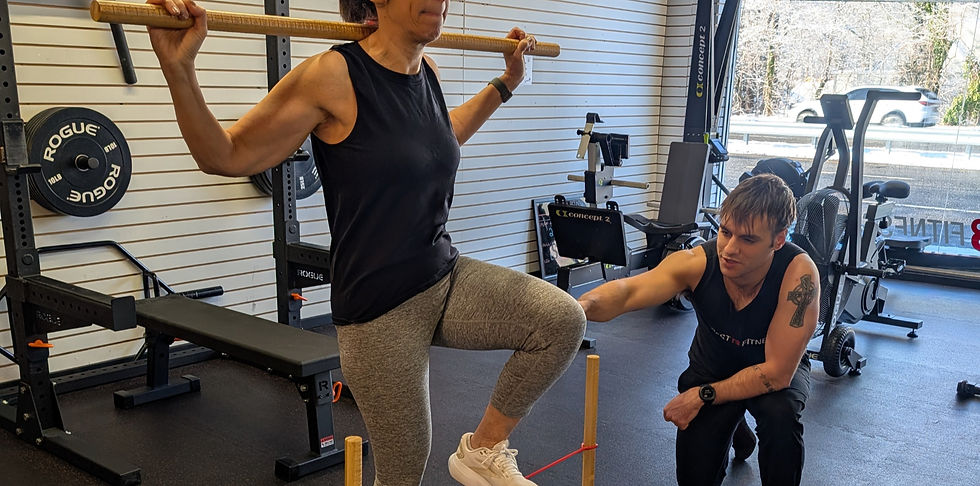
Everyone comes in with a different story.
BRIDGE: For individuals with medical conditions who may benefit from coordinated communication with their healthcare team.
ADAPTIVE: For those returning after surgery, injury, or physical therapy.
FOUNDATIONS: For most adults looking to become healthier, stronger, lose weight, or simply feel better.
PERFORMANCE: For athletes looking to improve strength, speed, power, conditioning, and sport performance.
The goal isn't to fit you into a program.
It's to fit the program to you.
Why 12 Weeks?
Your body doesn't change overnight.
Muscles become stronger.
Your heart becomes more efficient.
Movement becomes easier.
Healthy habits become routines.
Research shows these changes take time, which is why 12 weeks is commonly used to build real progress—not quick fixes. “Inactive adults experience a 3% to 8% loss of muscle mass per decade, accompanied by resting metabolic rate reduction and fat accumulation. Ten weeks of resistance training may increase lean weight by 1.4 kg, increase resting metabolic rate by 7%, and reduce fat weight by 1.8 kg.” (Wescott)
In our program, a 2 week ramp-in, and ten (10) weeks of training allow for optimal results
Throughout the program, your workouts are adjusted as you improve, your nutrition is reviewed, and your progress is measured so you're always moving forward.
Schedule your Free Consultation today
What Happens After 12 Weeks?

The goal is to help you become confident enough to make fitness part of your life.
It is important to continue with coaching because the the accountability and continued progression gives the best results.
Success isn't measured by finishing 12 weeks.
It's measured by what happens in week 13...and every week after that.
The Bottom Line
Exercise works best when it matches your goals, your health, and your current abilities.
That's why every program begins with understanding the person—not just writing the workout.
Schedule your Free Consultation today
References
Garber, C. E., Blissmer, B., Deschenes, M. R., Franklin, B. A., Lamonte, M. J., Lee, I.-M., Nieman, D. C., Swain, D. P., & American College of Sports Medicine. (2011). Quantity and quality of exercise for developing and maintaining cardiorespiratory, musculoskeletal, and neuromotor fitness in apparently healthy adults: Guidance for prescribing exercise. Medicine & Science in Sports & Exercise, 43(7), 1334–1359. https://doi.org/10.1249/MSS.0b013e318213fefb
Westcott WL. Resistance Training Is Medicine. 2012.
Comments